
.webp)


FBT on Christmas gifts
Employee Christmas gifts such as gift cards and vouchers are unclassified fringe benefits. They’re free of fringe benefit tax (FBT) only if you stay under both limits: 300peremployeeperquarter(1,200 a year for annual filers) and $22,500 across all employees over a year. If you exceed either limit, FBT applies to the full amount, not just the excess.
Christmas is when most businesses give the most, all in one quarter. That makes October to December the quarter most likely to tip you over a threshold.
Is the $300 limit an allowance I can deduct?
No. It’s an on/off exemption, not a deduction. If you give an employee $500 of gifts in a quarter, FBT is due on the whole $500, not just the $200 over the line.
At the single rate of 63.93%, that’s about $320 of FBT, so your $500 gift actually costs around $820. Alternate rate calculations can lower the effective rate depending on each employee’s pay, so check with your adviser.
The second scenario is the one that catches growing businesses. Each gift looks small, but the yearly total across the team is what tips you over.
What changed in FBT for 2026?
The gift thresholds didn’t change. The $300, $1,200 and $22,500 limits still apply.
What did change is the line between PAYE and FBT. Under the Taxation (Annual Rates for 2025–26, Compliance Simplification, and Remedial Measures) Act 2026, from 1 April 2026 employers can choose to treat a reimbursement of an employee’s personal cost as an unclassified benefit taxed through FBT, instead of grossing it up through PAYE.
That’s simpler for payroll, but it has a knock-on effect. Reimbursements you move into FBT sit in the same bucket as your gifts, so your running totals against the limits matter more than before. Earlier proposals to replace the thresholds with a $200 per-benefit exemption were not adopted.
Why unspent gift cards make it worse
Consumer NZ reports that 5 to 10% of gift card value typically goes unredeemed. That money stays with the card issuer, not your people.
FBT is calculated on the value you provide. If a gift card pushes you over a limit, its full face value is taxed whether or not it’s ever spent. You end up paying twice: once by losing value to breakage, and again in FBT on value nobody received.
Are cash bonuses treated the same?
No. Cash paid through payroll is salary or wages and is taxed through PAYE. The unclassified benefit limits apply to non-cash gifts such as gift cards, vouchers, hampers and experiences.
When is FBT on Christmas gifts due?
For quarterly filers, gifts given between 1 October and 31 December fall in the December quarter, and the return and payment are due on 20 January. Annual filers include these gifts in their year-end return.
Where Extraordinary and TaxLab fit
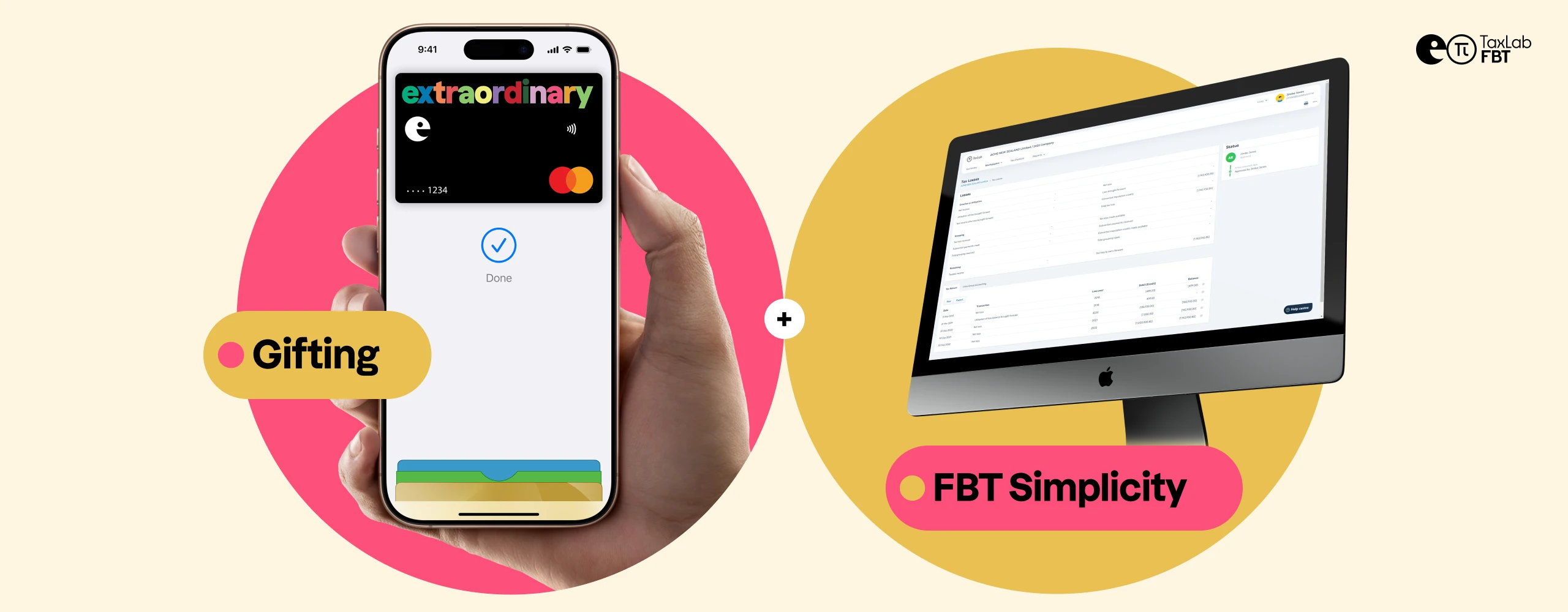
Extraordinary sends digital gifts that land in minutes and work with Apple Pay or Google Pay. Every dollar is tracked, and unspent funds return to your business rather than a card company.
When it’s time to file, download your TaxLab FBT report from Extraordinary and upload it into TaxLab. There’s no mapping, and TaxLab applies the de minimis calculations, runs error checks and prefills your return. Read how the integration works
New customers who sign up to both by Friday 11 December 2026 get three months of TaxLab FBT free.
Learn more at our free webinar
Join Extraordinary and TaxLab on Thursday 29 October 2026 at 12:30pm NZDT for 45 minutes on Christmas gifting and FBT. You’ll hear real FBT insights from Robyn Walker, Tax Partner at Deloitte, learn how to classify gifts correctly, and see the integration live.
Frequently asked questions
Do I pay FBT on a Christmas gift card for employee in NZ?
Not if you stay under $300 per employee per quarter and $22,500 across all employees per year. If you exceed either, FBT applies to the full value.
What is the FBT limit for employee gifts in 2026?
The limits are unchanged: $300 per employee per quarter, $1,200 per year for annual filers, and $22,500 across all employees.
Is the $300 limit per gift or per employee?
It’s per employee per quarter, and it covers every unclassified benefit that person receives.
What FBT rate applies to gifts?
The single rate is 63.93%. Alternate rate calculations can give a lower effective rate.
Does unspent gift card value still count for FBT?
Yes. A gift card’s full face value counts once you cross a limit, whether or not it’s spent.
Can I put employee reimbursements through FBT now?
Yes. From 1 April 2026, you can choose to treat reimbursements of employees’ personal costs as unclassified benefits taxed through FBT.
When is FBT on Christmas gifts due?
For quarterly filers, the December quarter return and payment are due on 20 January.
Extraordinary provides the platform and reporting, not tax advice. Confirm your FBT treatment with your tax adviser.
Sources to link: IRD FBT limits · IRD rates · Deloitte, PAYE or FBT (May 2026) · Consumer NZ · TaxLab integration
Related Resources
Gifting meets FBT. The integration you need.

Cut the cost of the commute. A playbook for Govt. & Public Sector employers.