
.webp)


How Salary Sacrifice For Public Transport Works in NZ
Cut your commute cost by 30% or more using pre-tax income. Here's how the scheme works, with an Inland Revenue product ruling.
.png)
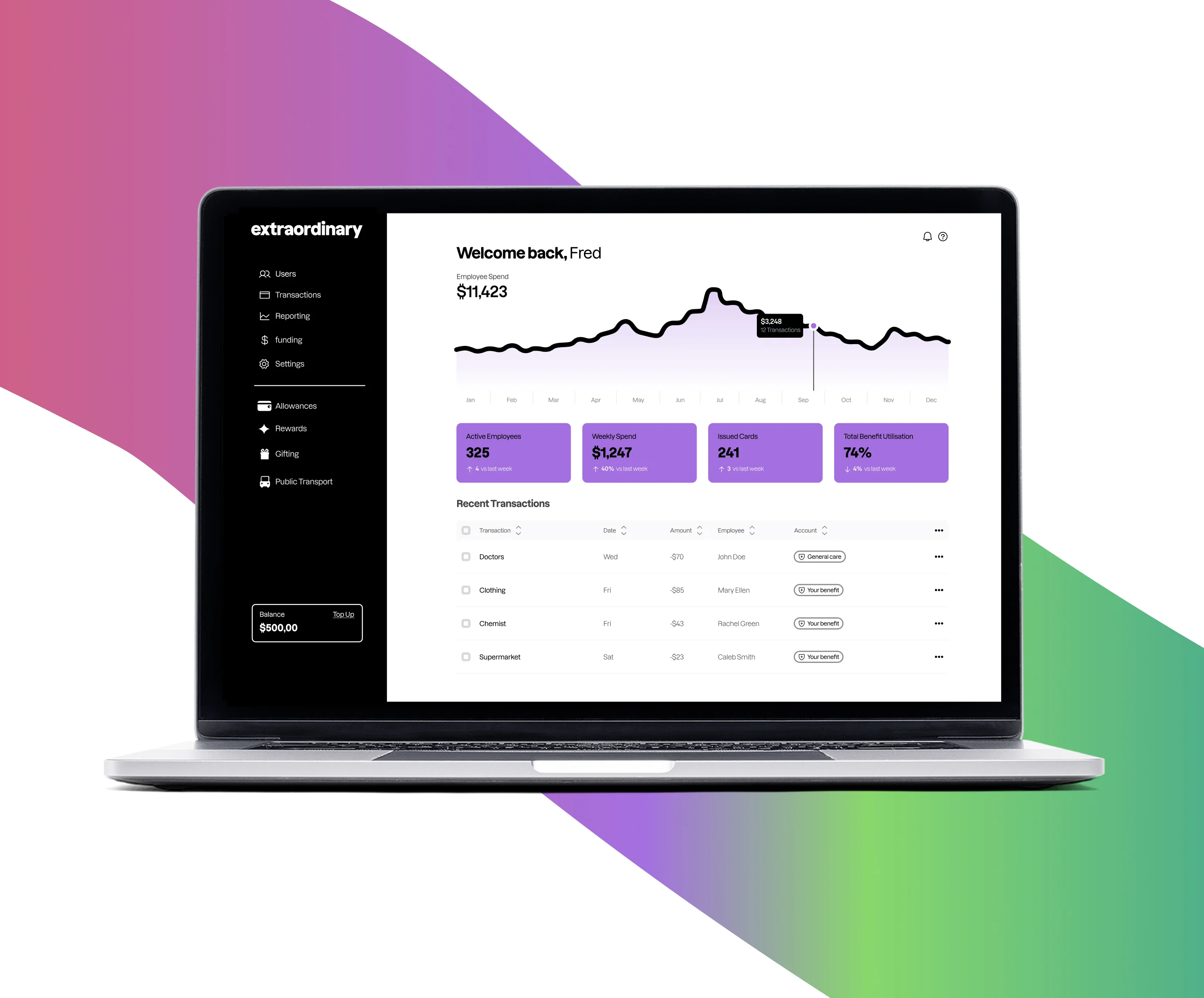
You could instantly cut the cost of your daily commute by 30% or more thanks to a recent Inland Revenue ruling, New Zealand employees can now use their pre-tax income to pay for public transport. Salary sacrifice for public transport happens when an employee agrees to reduce their gross salary by what they spend on commuting, and that amount gets loaded onto a payment card for trains, buses and ferries. The sacrificed amount is paid from pre-tax income, so the employee pays less PAYE on it.
Until mid-2025 the arrangement wasn't legally workable for public transport in New Zealand. That changed when Inland Revenue issued Product Ruling BR Prd 25/03, which confirms the Extraordinary platform qualifies for the FBT exemption.
"For the first time," Extraordinary CEO Steven Zinsli told Channel Life NZ, "employees can access their pre-tax income to pay for public transport." Zinsli pitched the scheme as a way to lift take-home pay while supporting employer sustainability and return-to-office goals.
The scheme has been welcomed across the political spectrum. Auckland Mayor Wayne Brown joined Extraordinary's launch at Britomart station, and Greens transport spokesperson Julie-Anne Genter described it as a "huge win" for cheaper public transport.
What is salary sacrifice?
Salary sacrifice is an agreement where an employee swaps a portion of their pre-tax salary for a non-cash benefit. They earn less on paper, pay less PAYE, and get the benefit instead.
In New Zealand, salary sacrifice has been uncommon, mostly limited to KiwiSaver top-ups. The public transport variant is newer, and relies on a specific FBT exemption created in 2023.
The arrangement only works prospectively. The salary reduction must be agreed before the pay period it applies to, and it has to be a genuine cut to base salary for all purposes including KiwiSaver. The employee signs a 12-month sacrifice agreement and can exit early with one week's notice, but can't re-enter the scheme for 12 months from initial entry.
Is salary sacrifice for public transport legal in New Zealand?
Yes, and there's a binding Inland Revenue ruling to prove it.
The legal basis is Section CX 19C of the Income Tax Act 2007, which provides a fringe benefit tax exemption for employer-subsidised public transport used mainly for commuting between home and work. RSM New Zealand describes the section as a rule "desigened to level the playing field" between employer-provided car parks (long FBT-exempt) and public transport subsidies (which weren't until 2023).
On 16 May 2025, Inland Revenue issued Product Ruling BR Prd 25/03, confirming that salary sacrifice for public transport via the Extraordinary platform qualifies under Section CX 19C.
Writing for Deloitte's June 2025 Tax Alert, Tax Partner Robyn Walker noted that the Extraordinary Pay ruling "provides an avenue for employers to start using the public transport FBT exemption". The ruling overcomes practical obstacles that had previously prevented many employers from utilising it.
The ruling covers which cards qualify (AT HOP, Snapper, Metrocard, Bee Card), how to structure the salary sacrifice agreement, and the compliance test for commuting use. "Mainly" is treated as 50% or more of card spend on commuting between home and work. Occasional personal use is permitted as long as commuting remains the dominant use.
How much can employees save?
Savings come from paying for public transport with pre-tax income. The sacrificed amount never appears as taxable salary, so the employee avoids PAYE on it. For most NZ employees that's 30%+ off the cost of commuting.
An employee spending $50/week sacrifices $2,600 a year. At a 30% marginal tax rate, they save approximately $900+ annually.
Savings scale with the marginal tax rate, so higher earners save proportionally more:
$70,000 salary, $50/week commute: ~$900 estimated annual saving ($17.38/week)
$80,000 salary, $50/week commute: $964 estimated annual saving ($18.50/week)
Use the public transport savings calculator to run the numbers for your salary and commute.
For the underlying mechanics, RSM New Zealand's worked example breaks down the PAYE component specifically if you want to read more.
The salary reduction also flows through to five other income-based calculations:
- KiwiSaver employer and employee contributions
- ACC Earners' Levy
- Student loan repayments
- Child support obligations
- Working for Families tax credits
All five are calculated off the reduced salary or taxable income. Employees in any of these categories, particularly those near Working for Families thresholds, should model their personal position before opting in.
What it costs the employer
The Extraordinary platform fee is $4.17 per active employee per month plus 5% of the value loaded. Paid by the employer, on top of what employees load. Never taken from their pay.
That makes it a fraction of the cost of giving the same take-home boost through a pay rise. A pay rise is taxed before it reaches your people. A public transport salary sacrifice is paid from pre-tax income, so every dollar an employee commits goes further.
At a typical $50/week sacrifice, the employer is around $28 ahead per participating employee per year on KiwiSaver savings alone. Employer ACC workplace levies vary by industry classification and are not assumed in this modelling.
Employers don't pay FBT on amounts loaded to the card. The card is restricted at the merchant level to the four qualifying transit systems (AT HOP, Snapper, Metrocard, Bee Card), so non-qualifying spend is prevented rather than corrected after the fact. Unused balances return to the employer; they don't become taxable income for the employee.
With the foundations in place, Spark is now focused on expanding public transport benefits across the organisation. "It's a no-brainer," says Laurence Hopkins, Lead - Reward, People Tech & AI at Spark. "It puts money back in people's pockets and supports more sustainable travel."
How does it actually work?
The employer signs up through Extraordinary, sets contribution limits and eligibility rules, and connects the platform to their payroll cycle. The sacrifice is configured in payroll as a pre-tax salary reduction (not a post-tax deduction). Employees opt in via a 12-month salary sacrifice agreement, specifying their weekly sacrifice amount.
Each pay cycle, the sacrificed amount loads onto the employee's Extraordinary Card, a prepaid Mastercard with merchant-level controls. The card is issued digitally and added to the employee's phone wallet. Per BR Prd 25/03, the four qualifying transit systems are:
- AT HOP (Auckland)
- Snapper (Wellington and some regional services)
- Metrocard (Canterbury and Christchurch)
- Bee Card (Waikato, Bay of Plenty, Hawke's Bay, Manawatu-Whanganui, Nelson, Tasman, Marlborough and West Coast)
Motu Move (National Ticketing System), will integrate as it rolls out
The Extraordinary card can be added to both Apple Pay and Google Pay digital wallets, so employees can tap their phone at transit gates without carrying a separate card. Additionally, employees can use it to top up their existing AT HOP, Snapper, Metrocard or Bee Card, or to tap on directly at the gate where contactless payment is supported.
Who is it available for?
Any New Zealand employer can offer salary sacrifice for public transport. There's no minimum headcount, no industry restriction, and no requirement to be based in a major centre.
Employees need to be permanent (full-time or part-time). After the salary reduction, their gross pay must still sit above the statutory minimum wage.
Employees with highly variable commute patterns can still participate, but the sacrifice amount should be set conservatively to avoid over-sacrificing relative to actual spend.
Frequently asked questions
What happens if an employee leaves or wants to exit early? The sacrifice agreement terminates with employment. Mid-term, employees can exit with one week's notice but can't re-enter the scheme for 12 months from their initial entry date.
What happens during unpaid leave? The sacrifice agreement pauses (an Inland Revenue requirement). Paid annual leave doesn't trigger a pause. The 12-month period extends by the length of the unpaid leave.
Can employees be refunded if they sacrifice more than they use? No. Sacrificed amounts are non-refundable. Unused balances on the card return to the employer at the end of the agreement.
Can employers choose which employees are eligible? Yes. Employers set eligibility criteria through the Extraordinary platform.
Does the card work for ferries? Yes, where ferries are part of a qualifying public transport network (e.g. Auckland's harbour ferries on AT HOP).
What is the 50% commuting rule? BR Prd 25/03 requires that at least 50% of the employee's card spend be on qualifying commuting travel. Employers monitor this through the Extraordinary platform's reporting.
Is this different to a transport allowance? Yes, significantly. A transport allowance is a taxable payment; the employee pays PAYE on it. Salary sacrifice under BR Prd 25/03 operates on pre-tax income. A $50/week transport allowance and a $50/week salary sacrifice arrangement produce very different take-home outcomes for the employee.
The bottom line
Salary sacrifice for public transport gives employees a meaningful reduction in their commute cost, funded entirely from their own pre-tax income. Employers set it up once, report through a single platform, and pay a platform fee that's typically offset by the KiwiSaver employer contribution savings.
The savings are real. On a $70,000 salary spending $50 per week on public transport, employees save around $900 annually. On $80,000, the saving is $964 per year.
Use the public transport savings calculator to run the numbers for your salary and commute.Salary sacrifice for public transport gives employees a meaningful reduction in their commute cost, funded entirely from their own pre-tax income. Employers set it up once, report through a single platform, and pay a platform fee that's typically offset by the KiwiSaver employer contribution savings.
The arrangement is backed by a binding Inland Revenue product ruling. There's no legal ambiguity about how it works; BR Prd 25/03 sets it out in full.
References
- Inland Revenue, Product Ruling BR Prd 25/03 (issued 16 May 2025)
- Income Tax Act 2007, Section CX 19C
- Deloitte New Zealand, "New product ruling opens up public transport FBT exemption" (June 2025)
- RSM New Zealand, "Tax-free commutes: a guide for NZ employers" (April 2026)
- BusinessDesk, "Extraordinary unlocks pre-tax public transport perks for workers" (15 June 2025)
- Channel Life NZ, "Extraordinary launches pre-tax commute card in New Zealand" (16 June 2025)
- Extraordinary public transport savings calculator (Deloitte-prepared tax model)
Related Resources

FBT on Christmas gifts
Gifting meets FBT. The integration you need.